
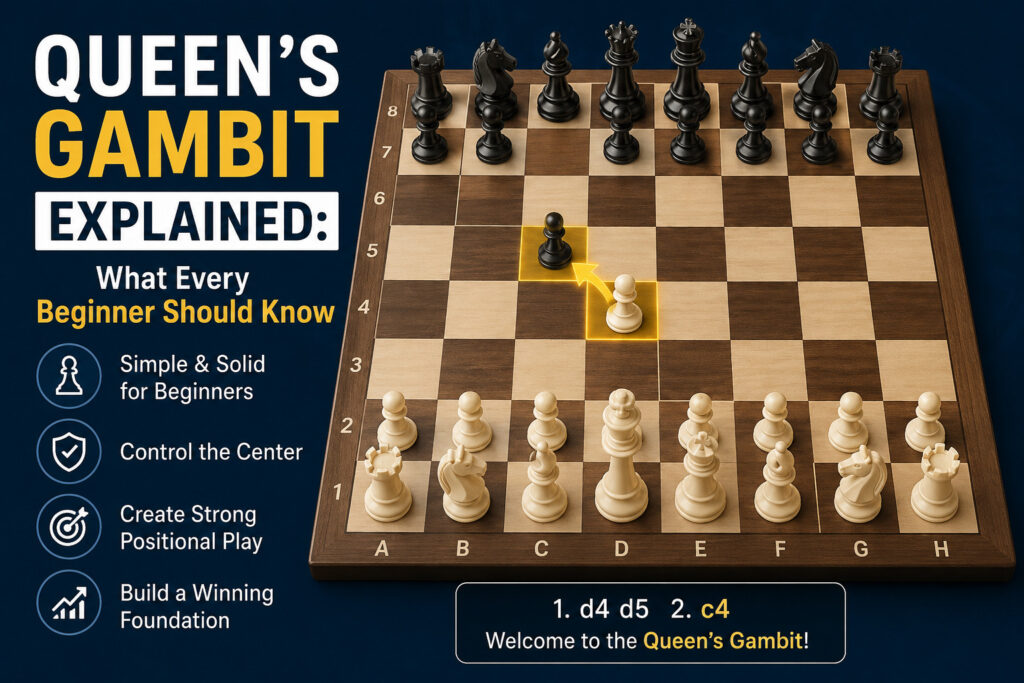
What Is the Queen’s Gambit?
The Queen’s Gambit is one of the oldest and most respected chess openings. It starts like this:
- d4 d5
- c4
White opens with the queen’s pawn, and Black mirrors the move. Then White plays c4, offering the c-pawn in exchange for greater influence over the center of the board.
It is called a “gambit” because White is offering material, in this case a pawn, in return for a positional or developmental advantage. The purpose of challenging Black’s d5-pawn is simple: if Black takes on c4, White gains extra options for development and central play. If Black declines, White still ends up with a strong, flexible center. Either way, the opening is fundamentally about who controls the middle of the board, not about who wins a stray pawn.
Why Does White Offer the c-Pawn?
Beginners often see 2.c4 and assume White is simply giving away a pawn for nothing. That is not accurate. The c-pawn is offered for a clear strategic purpose.
By playing c4, White challenges Black’s d5-pawn, which is currently the most important pawn on the board for both sides. If Black accepts the gambit, White can often regain the pawn later and, in the meantime, gains extra freedom to develop pieces naturally. Even if White never wins the pawn back in some lines, the resulting position usually favors active piece play and central space.
This is one of the most useful lessons the Queen’s Gambit teaches a new player: material is not the only thing that matters in chess. Central control, piece development, space, and activity often matter just as much, and sometimes more, than holding on to every pawn.
Is the Queen’s Gambit Really a Gambit?
Yes, the Queen’s Gambit can be a good opening for beginners because it teaches central control, development, pawn structures, and strategic planning in a very direct way. As Chess.com’s opening library notes, it remains a favorite among elite players and newcomers alike because of this balance between simplicity and depth.
It introduces players to real positional ideas without requiring heavy memorization. It can also lead to many different types of middlegame positions, which helps a beginner build broader chess understanding rather than narrow, one-track knowledge.
That said, it is not automatically the “best” opening for every beginner. What matters most is understanding why each move is played. A player who memorizes ten moves of theory without understanding the reasoning will struggle the moment an opponent deviates. A player who understands the principles behind d4 and c4 will be able to handle a wide range of responses with confidence.
The Main Queen’s Gambit Variations
Black has two primary ways to respond to 2.c4, and each leads to a very different type of game.
Queen’s Gambit Accepted
- d4 d5
- c4 dxc4
Here, Black simply takes the offered pawn. White usually responds by developing pieces and preparing to challenge Black’s extra pawn later, often with moves like e3 and Bxc4.
The key idea for White is not to rush to win the pawn back immediately. Development and king safety come first. For Black, the extra pawn is only temporary in many lines, so the priority should be completing development rather than trying to defend the pawn at all costs.
Queen’s Gambit Declined
- d4 d5
- c4 e6
In the Queen’s Gambit Declined, Black keeps the pawn on d5 and supports it with e6. This leads to a more closed, strategic type of game where pawn structure and piece placement matter a great deal.
White continues developing normally and looks for ways to build central and positional pressure. The QGD is known for teaching players how to handle pawn structures thoughtfully, which is a skill that carries over into many other openings.
What Are the Key Ideas in the Queen’s Gambit?
This is the most important part of understanding the opening. The moves themselves matter less than the ideas behind them.
1. Control the Center Playing d4 and c4 gives White influence over the four central squares, which are the most valuable real estate on the board. Central control makes it easier to move pieces to either side of the board quickly.
2. Challenge Black’s d5-Pawn The whole point of c4 is to put pressure on d5. This forces Black to make a decision early, which can create small but meaningful advantages for White.
3. Develop the Pieces Knights should generally come out before bishops, and both should be developed before moving the queen. In the Queen’s Gambit, White typically brings out the knight to f3 or c3, then develops the bishops, and prepares to castle.
4. Protect the King Castling early is usually more important than chasing a single pawn. A safe king allows a player to focus on strategy without worrying about sudden tactical problems.
5. Understand Pawn Structures The pawn structure that results from the Queen’s Gambit tells you where your pieces belong. A solid structure supports a knight on one square, while an open structure might favor active bishops.
6. Look for Useful Pawn Breaks A pawn break is a pawn move that challenges the opponent’s structure and opens lines for your pieces. Beginners do not need to memorize specific breaks yet, but should start noticing when one becomes available.
7. Create a Middlegame Plan The opening moves should lead naturally into a plan. GMChessPrep’s coaching approach connects opening understanding directly to middlegame planning, tactics, and practical decision-making, so students learn to think several steps beyond the opening itself.
Is the Queen’s Gambit Good for Beginners?
Yes, the Queen’s Gambit can be a good opening for beginners because it teaches central control, development, pawn structures, and strategic planning in a very direct way.
It introduces players to real positional ideas without requiring heavy memorization. It can also lead to many different types of middlegame positions, which helps a beginner build broader chess understanding rather than narrow, one-track knowledge.
That said, it is not automatically the “best” opening for every beginner. What matters most is understanding why each move is played. A player who memorizes ten moves of theory without understanding the reasoning will struggle the moment an opponent deviates. A player who understands the principles behind d4 and c4 will be able to handle a wide range of responses with confidence.
How to Play the Queen’s Gambit as a Beginner
Step 1: Start With d4 This move stakes a claim in the center immediately.
Step 2: Play c4 This challenges Black’s d5-pawn and sets the tone for the entire game.
Step 3: Develop Your Knights Bring your knights out early, usually to f3 and c3, before moving other pieces.
Step 4: Develop Your Bishops Look for good diagonals rather than moving the same piece more than once without a reason.
Step 5: Castle Get your king to safety before starting any complicated plans.
Step 6: Study the Pawn Structure Once the opening moves are complete, look at the pawn structure and ask what it tells you about where your pieces belong.
Step 7: Review Your Games After playing the Queen’s Gambit in a real game, go back and look at which decisions were sound and which ones need improvement. This kind of structured review, supported by guided analysis, is central to how students improve at GMChessPrep.
Common Beginner Mistakes in the Queen’s Gambit
- Trying to win the c-pawn back immediately instead of developing
- Memorizing moves without understanding the reasoning behind them
- Moving the queen out too early
- Ignoring piece development in favor of pawn moves
- Delaying castling for too long
- Playing too many pawn moves in the opening
- Ignoring what the opponent is threatening
- Focusing only on material instead of position
- Not studying the middlegame positions that result from the opening
- Copying grandmaster moves without understanding the specific position
Each of these mistakes usually comes from the same root cause: treating the opening as a memorized sequence instead of a set of ideas.
Queen’s Gambit Accepted vs Queen’s Gambit Declined
| Factor | Queen’s Gambit Accepted | Queen’s Gambit Declined |
| Black’s response | Takes the c4-pawn | Keeps the d5-pawn |
| Main idea | Accept the offered pawn | Maintain central control |
| White’s goal | Development and central activity | Pressure and positional play |
| Pawn structure | Can become more open | Often more solid |
| Beginner focus | Development and recovering material | Piece placement and long-term plans |
| Typical lesson | Don’t chase pawns | Understand pawn structures |
Queen’s Gambit Opening Moves for Beginners
The core sequence looks like this:
- d4 d5
- c4
From here, Black usually chooses one of two paths:
- 2…e6 leads into the Queen’s Gambit Declined
- 2…dxc4 leads into the Queen’s Gambit Accepted
Rather than memorizing a long list of follow-up moves, beginners should focus on recognizing which path the game has taken and applying the relevant ideas from that variation. The correct continuation always depends on the specific position in front of you.
What Can the Queen’s Gambit Teach You About Chess?
Beyond the opening itself, the Queen’s Gambit is a useful teaching tool for broader chess skills, including:
- Central control
- Efficient development
- King safety
- Piece coordination
- Reading pawn structures
- Strategic planning
- Tactical awareness
- Patience
- Weighing material against position
- Thinking ahead rather than reacting move by move
These are the same principles that carry through strategy, tactics, middlegame planning, and tournament preparation. Learning one opening well, with real understanding, tends to make every other part of a player’s game stronger.
Is There a “Stupidest” Chess Opening?
There is no opening that can fairly be called objectively “stupid.” Some openings are riskier, more passive, or less aligned with standard opening principles, but their actual strength depends heavily on the position, the players involved, and how well each side understands the resulting ideas.
A move that looks strange at first glance can sometimes serve a specific tactical or strategic purpose. For beginners, the more useful goal is learning sound opening principles first, such as central control and development, before experimenting with unusual or offbeat openings. Understanding why a move works will always be more valuable than memorizing which openings have a reputation, good or bad.
What About Beth Harmon in The Queen’s Gambit?
Beth Harmon is the fictional main character of the television series The Queen’s Gambit, which introduced chess to a much wider audience. Her personality and behavior in the show are part of a fictional story, and there is no established basis for diagnosing her, or discussing her, with any specific medical or psychological label. This article focuses on the actual chess opening rather than the show, but it is worth noting that the series played a real role in renewing public interest in chess and in this opening specifically.
How to Study the Queen’s Gambit Effectively
1. Learn the Opening Principles Understand why d4 and c4 are played before anything else.
2. Learn the Main Responses Know the basic difference between the Accepted and Declined variations.
3. Study Model Games Instructive games show how strong players carry out plans in these structures.
4. Practice Positions Work through tactical and strategic exercises based on Queen’s Gambit pawn structures.
5. Play Real Games Apply what you have learned in actual games rather than only watching instructional content.
6. Review Your Games Look back at your games to spot recurring problems.
7. Get Structured Feedback Coaching can help identify specific weaknesses and build a focused training plan. GMChessPrep’s private lessons, for example, use game review and tailored study plans to help students preparing for tournament play.
When Should a Beginner Learn Opening Theory?
Beginners should start with basic opening principles rather than deep theory. Memorizing fifteen or twenty moves is not necessary to begin playing the Queen’s Gambit effectively. Instead, learn the common structures and plans that come out of the opening, and study specific variations gradually as your rating and experience grow. In the early stages, tactics, development, king safety, and piece activity deserve more attention than opening memorization.
Queen’s Gambit vs Learning Opening Principles
| Learning Approach | What It Gives You |
| Memorizing moves | Short-term opening knowledge |
| Understanding principles | Flexible decision-making |
| Studying model games | Strategic understanding |
| Playing practice games | Practical experience |
| Reviewing games | Identifying mistakes |
| Coaching | Personalized guidance |
Strong chess improvement almost always requires more than opening memorization. It requires understanding how the opening connects to everything that follows.
Why Learn Chess Openings With a Grandmaster Coach?
Learning opening principles directly from an experienced player can shorten the path to real understanding. Instead of memorizing disconnected moves, a coach can help a student see the ideas behind them, review real games, identify recurring mistakes, and build a structured plan that connects opening knowledge with middlegame and endgame skills.
GMChessPrep Academy was founded in January 2013 by Grandmaster Rashad Babaev and offers structured chess instruction for students of different ages and skill levels. The academy’s programs are designed to help students progress from foundational skills toward practical tournament preparation, through online group lessons, online private lessons, and in-person group lessons.
Before Playing the Queen’s Gambit
- ✅ Know how the pieces move
- ✅ Understand basic opening principles
- ✅ Understand why White plays d4
- ✅ Understand why White plays c4
- ✅ Know the difference between QGA and QGD
- ✅ Know basic development principles
- ✅ Understand castling
- ✅ Know basic tactics
- ✅ Be prepared to analyze your games
- ✅ Focus on ideas rather than memorization
Want to Learn the Queen’s Gambit? Start with the basic ideas. Learn the main responses. Practice the opening in real games. Review your mistakes. Study model games. Work on tactics and positional understanding. Consider structured chess coaching if you want personalized feedback.
Ready to improve your chess? Explore GMChessPrep’s lessons and learn from Grandmaster Rashad Babaev through structured chess training designed for different skill levels. GMChessPrep offers online group lessons, private lessons, in-person group lessons, and after-school lessons.
FAQs
What is the Queen’s Gambit in chess?
It is a chess opening that begins with 1.d4 d5 2.c4, where White offers the c-pawn to challenge Black’s control of the center.
Is the Queen’s Gambit good for beginners?
Yes, it can be a strong choice for beginners because it teaches central control, development, and pawn structure, as long as the focus stays on understanding rather than memorization.
What are the first moves of the Queen’s Gambit?
The opening begins with 1.d4 d5 2.c4, after which Black usually responds with either 2…dxc4 or 2…e6.
Why is the Queen’s Gambit called a gambit?
It is called a gambit because White offers a pawn, the c-pawn, in exchange for greater central influence and development.
What is the Queen’s Gambit Accepted?
This is the variation where Black takes the offered pawn with 2…dxc4, leading to a position where White typically develops quickly and looks to regain the pawn later.
What is the Queen’s Gambit Declined?
This is the variation where Black keeps the d5-pawn and supports it, usually with 2…e6, leading to a more solid and strategic type of game.
What are the key ideas in the Queen’s Gambit?
The main ideas include central control, challenging Black’s d5-pawn, efficient piece development, king safety, and understanding the resulting pawn structure.
Is the Queen’s Gambit hard to learn?
The basic ideas are accessible to beginners. It becomes more complex at higher levels, but a solid grasp of the underlying principles is enough to play it well early on.
Should beginners memorize Queen’s Gambit theory?
No. Beginners benefit far more from understanding the principles behind the moves than from memorizing long variations.
What is the best way to learn the Queen’s Gambit?
Learn the core ideas first, study model games, practice in real games, review your mistakes, and consider structured coaching for personalized feedback.
Conclusion
The Queen’s Gambit is one of the most instructive openings a beginner can learn, not because of the specific moves involved, but because of the ideas behind them. White’s offer of the c-pawn is a strategic tool for gaining central influence and development, not a careless giveaway. Whether Black accepts the gambit or declines it, the resulting positions teach valuable lessons about pawn structure, piece activity, and long-term planning.
Rather than memorizing move sequences, beginners get the most value from understanding why each move is played. That mindset carries far beyond this single opening and strengthens the way a player approaches chess as a whole. Ready to improve your chess? Explore GMChessPrep Academy’s structured lessons and learn opening principles, strategy, and practical tournament preparation directly from Grandmaster Rashad Babaev.
