
Quick Answer: Competitive chess tournaments for kids are structured, rated or unrated events where children play several games against similarly skilled opponents over one or more days. Most scholastic tournaments run four to six rounds in a single day, follow USCF rules, and separate players into sections by rating or grade level so beginners are not matched against advanced players.
Your child just came home and announced they want to play in a real chess tournament. Maybe they have been taking lessons for a few months, or maybe they just beat you three times in a row and feel unstoppable. Either way, you are probably left with more questions than answers: How does this even work? What do you bring? What do you do for five hours while your child plays?
This guide answers every question a parent asks before their child’s first competitive chess tournament, from how sections work to what to expect on tournament day.
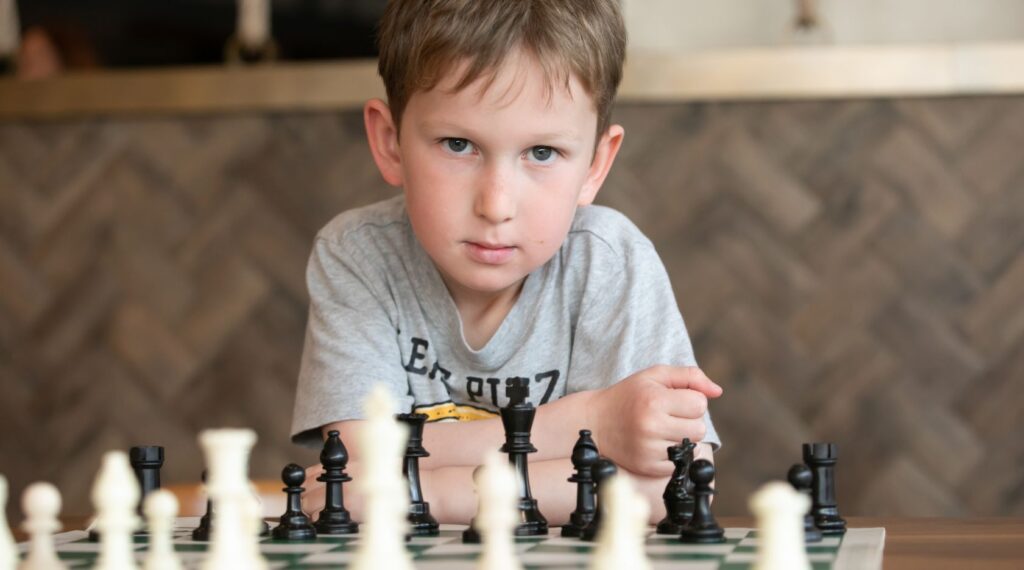
What Is a Competitive Chess Tournament for Kids?
A youth chess tournament is an organized event where children play multiple games, usually against different opponents each round, under official time controls and rules. Most scholastic tournaments in the US use the Swiss system, which means players are not eliminated after a loss. Instead, everyone plays every round and gets paired against someone with a similar score.
Tournaments are typically divided into sections by age, grade, or US Chess rating, such as K-3, K-5, K-8, or Under 800. This keeps games fair and gives beginners a realistic shot at winning games and earning trophies.
When Should a Child Start Playing in Tournaments?
Most coaches recommend a child’s first tournament once they can play a complete game independently, understand basic notation, and follow tournament etiquette like sitting quietly and not asking a parent for help mid-game. For many kids, this happens between ages 6 and 9, though motivated younger players sometimes start earlier with support from a coach.
A good sign of readiness is not rating or skill level. It is whether the child can handle sitting through a loss without needing a parent nearby. If they are not there yet, one more session of lessons or a smaller local club event is a better starting point than a big tournament.
Types of Chess Tournaments for Kids
Not all tournaments look the same. Here is how the major formats differ:
| Tournament Type | Games Rated? | Typical Length | Best For |
| Scholastic Unrated | No | Single day | First-time players, ages 4-8 |
| Scholastic USCF Rated | Yes | Single day, 4-6 rounds | Players ready to build an official rating |
| Online Rated Tournaments | Yes | 1-2 hours | Practice between in-person events |
| Regional/State Championships | Yes | 1-2 days | Intermediate to advanced players |
| National Championships | Yes | 3-5 days | Top-rated competitive players |
Beginners almost always start in unrated or lightly-rated scholastic sections before moving into fully USCF-rated events as their confidence and rating grow.
What Kinds of Chess Tournaments Happen Throughout the Year?
Every year brings a mix of local scholastic tournaments and major national championships. National-level events like the US Junior, Girls, and Senior Championships and the US Open Championship are held annually, along with state and regional scholastic championships hosted throughout the year in nearly every state.
For families in Northern Virginia, GMChessPrep also runs its own scholastic tournament designed as a low-pressure entry point for a child’s first competitive event.
Tournament schedules and listings can change throughout the year. Parents should check the US Chess Federation tournament finder for the latest events by state, location, and age group.
What Do Parents Do During a Chess Tournament?
This is one of the most common questions from first-time chess parents, and the honest answer surprises most people: not much, and that is by design.
During the game, parents are not allowed near the board or inside the playing hall in most tournaments. Your child sits alone with their opponent, a clock, and a scoresheet. There is no coaching, no hand signals, and no checking in. This can feel strange the first time, but it is a core rule of fair play.
Between rounds, your job shifts from spectator to logistics support:
-
- Get your child food, water, and a short break away from the playing hall
-
- Keep the mood calm and light, win or lose
-
- Save any move-by-move analysis for the car ride home, not the hallway
-
- Let your child decide whether they want to talk about the game at all
Most tournaments designate a separate waiting area, often called a “skittles room,” where parents wait and children can relax between rounds. A full day event with four or five rounds can run from mid-morning into the late afternoon, so bringing snacks, a book, and patience goes a long way.
Chess Tournament Dress Code: What to Wear (and Why Some Bans Exist)
Most scholastic tournaments in the US have a relaxed dress code. A clean, comfortable outfit and closed-toe shoes are usually all that is required. Some school-affiliated events ask players to wear their school colors or a team shirt for the School Team Trophy category.
Stricter dress codes apply mainly at elite international events, where formal attire and specific clothing rules are strictly enforced to maintain a professional, consistent standard. Youth scholastic tournaments rarely go beyond requiring neat, comfortable clothing and closed-toe shoes.
For youth scholastic events, parents generally do not need to worry about this level of formality. If a specific tournament does enforce a dress code, it will be listed clearly on the registration page.
How to Prepare Your Child for Their First Chess Tournament
A little preparation removes most of the stress from tournament day. Focus on these basics in the weeks before:
-
- Practice full games with a clock, not just puzzles, so time pressure feels familiar
-
- Review notation together so your child can record moves independently
-
- Walk through tournament etiquette: shaking hands, staying quiet, and calling an arbiter over for rule questions instead of solving it themselves
-
- Pack the essentials: a chess set (if allowed), a pencil, snacks, water, and a comfortable layer of clothing for cold tournament halls
-
- Set expectations around results, so the goal is effort and learning rather than a specific score
Common Mistakes Parents Make at Chess Tournaments
A few habits, usually well-intentioned, tend to add pressure instead of removing it:
-
- Hovering near the board or watching through a window during play
-
- Discussing the game loudly in the hallway where other players can overhear
-
- Asking the tournament director about a live game without a genuine rules question
-
- Reacting visibly to wins and losses in a way the child can see from across the room
-
- Focusing conversation entirely on the result instead of effort and specific moments played well
Stepping back and letting the tournament director, arbiter, and your child handle the game itself is one of the most useful things a parent can do.
How GMChessPrep Prepares Kids for Competitive Tournaments
GMChessPrep Academy, led by Grandmaster Rashad Babaev, builds tournament readiness directly into its coaching path rather than treating it as a separate add-on. Students in the Online Group Lessons program move through four levels, Foundations, Explorers, Challengers, and Strategists, with the later levels focused specifically on tactics, openings, and tournament preparation.
Students who want in-person competitive experience can also take part in GMChessPrep’s own tournaments, check our Tournaments page for upcoming dates and registration details. Families looking for a more immersive experience before a competitive season can also explore GMChessPrep’s After School Lessons and Summer Online Camp, both of which build the same tactical and time-management skills tournaments require.
Key Takeaways
-
- Chess tournaments for kids use the Swiss system, so no one is eliminated after a single loss
-
- Sections are grouped by age, grade, or rating, so beginners face appropriately matched opponents
-
- Parents cannot be near the board during play; their role is logistics and support between rounds
-
- Most youth tournaments have a relaxed dress code, unlike elite events with strict enforcement
-
- Preparing with full timed games and clear expectations reduces first-tournament stress significantly
FAQs
What Kinds of Chess Tournaments Happen Throughout the Year?
Major national events include the US Junior, Girls, and Senior Championships and the US Open Championship, held annually. Local scholastic tournaments run year-round in nearly every state, with GMChessPrep also hosting its own scholastic tournament in Northern Virginia. Check the US Chess Federation site for current dates and locations.
What do parents do at a chess tournament?
Parents wait outside the playing hall during games and are not permitted near the board. Between rounds, parents provide food, water, encouragement, and logistical support, saving detailed game discussion for after the event.
Why is wearing jeans not allowed in some chess tournaments?
Strict dress codes at elite events like FIDE’s World Rapid and Blitz Championship are meant to keep a professional, consistent standard across all competitors. Most youth scholastic tournaments do not enforce this level of formality.
Does my child need a USCF membership to play in a tournament?
Only for rated sections. Most scholastic tournaments also offer unrated sections that do not require a USCF membership, making them an easy entry point for first-time players.
How much does a first chess tournament typically cost?
Entry fees for local scholastic tournaments generally range from $20 to $50, depending on the number of sections and whether registration is done in advance or on the day of the event.
Ready to Prepare Your Child for Their First Tournament?
GMChessPrep’s structured lesson path and in-person scholastic tournaments give young players a clear, low-pressure route from their first lesson to their first tournament. Explore GMChessPrep’s tournament options and claim a free trial class today.
